
Seed that sticks to Florida sand
Hydroseeding in Tampa, FL
New lawns, construction sites and erosion control, timed to Tampa's rainy season and planned for sandy, fast-draining ground.
- We come out, measure, and quote in writing at no charge
- Seed choice matched to sun, irrigation and soil
- Silt fence and inlet protection set before earthwork
Grass on Sand, Rain on a Schedule
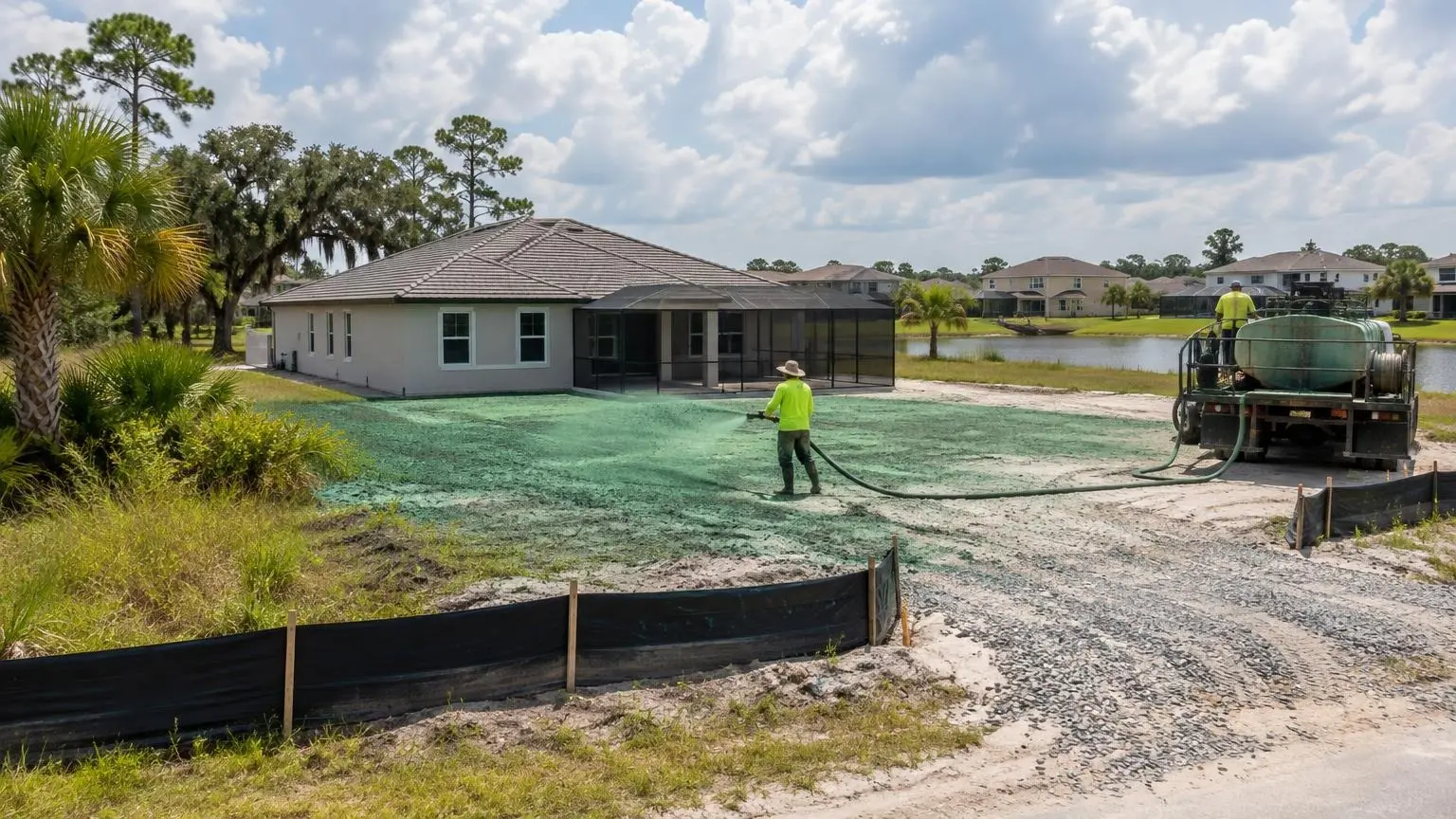
Hydroseeding in Tampa is a way of planting grass by pumping seed, wood fiber mulch, fertilizer and a tackifier, mixed with water, through a hose onto prepared ground. The tackifier glues the mix to the soil and the mulch holds moisture around the seed until it germinates. We do it for homeowners finishing a new build, for builders who need final stabilization, and for anyone with bare sand that keeps washing into the street. Tampa covers about 175 square miles, and more than a third of that is water: Old Tampa Bay, Hillsborough Bay, the Hillsborough River and the canals and ponds between them. Almost all of that land is low, with the city's highest point only 48 feet above sea level. On ground that flat, sediment does not have far to go before it reaches a ditch, a pond or the bay.
What the soil is actually like
The Florida state soil, Myakka, gives a good picture of what we work with. It formed from old marine deposits and is a key part of the state's flatwoods. A typical profile has a very dark gray sand surface about 5 or 6 inches thick, gray sand below that to about 26 inches, then a darker, organic-stained sand layer. Water moves through the top layers quickly, yet under natural conditions the water table can rise to within 10 inches of the surface for one to five months a year. So the same yard can be droughty in April and soggy in August.
UF/IFAS describes most Florida soils as sand-based, with little organic matter and low capacity to hold water or nutrients, and says soil around new homes is usually in worse shape than natural ground because of construction traffic. Compaction from trucks and equipment can reach more than 12 inches deep. That is why our quotes often include tilling, compost or topsoil before any seed goes down.
The two seasons that decide timing
Tampa averages 49.48 inches of rain a year (1991-2020 normals), but it does not arrive evenly. June through September carry most of it, with August averaging about 9 inches, and the rainy season runs from late May into early October. November is usually the driest month, and late March through May often brings brush-fire weather because the summer rains have not started. Hurricane season runs June 1 to November 30.
For seed, that pattern cuts both ways. Summer rain does a lot of the watering for you, and warm-season grasses grow fastest in summer heat. But a hard afternoon downpour on bare, freshly graded sand can cut rills and carry seed off before it roots. Spraying hydromulch with tackifier, and using blankets in swales and on slopes, is how we keep seed in place through those storms. In the dry months, seed will still grow, but someone has to water it.
Which grasses can be seeded here
This is the question most people do not ask until it is too late. St. Augustinegrass, the thick, wide-bladed lawn on many Tampa streets, cannot be grown from seed. UF/IFAS lists sod, plugs and sprigs as the only ways to start it. If you want St. Augustine, you want sod, and we will tell you that on the first visit.
The grasses that do come from seed here include bahiagrass and centipedegrass. Bahiagrass has a deep root system, persists better than other grasses in infertile sandy soil, and is a sensible choice for big lots or areas without irrigation. UF notes that the Argentine variety is usually preferred for lawns, while Pensacola throws more seed heads and suits roadsides. Bahia seed is slow to germinate, and it goes brown and dormant in long droughts, then recovers with rain. Centipedegrass is a low-input grass suited to central and north Florida that seeds at only about 4 ounces per 1,000 square feet. We also mix fast-cover seed into erosion jobs where the goal is stopping sediment rather than growing a showpiece lawn.
Best months to seed in Tampa
UF/IFAS says bahiagrass can be established any time of year in much of Florida, though growth slows in the cooler months. For centipedegrass, UF puts the best seeding window at April through July and warns that fall seeding is undesirable because young seedlings may not be ready for winter cold. Tampa's winters are mild, with hard freezes only every five to twenty years depending on location, but the occasional cold front still drops lows near 40 degrees for a day or two.
In practice: late spring and early summer give the strongest growth, with the rainy season starting to help. Midsummer works if the slurry is heavy enough to hold through storms. Fall can work for bahia with irrigation. Winter seeding is mostly for erosion control on job sites that cannot wait.
Sod, hydroseed or dry seed
Sod gives you a finished lawn the day it goes down, and UF/IFAS recommends it over seed on mounds steeper than about 10 percent. It also costs the most: HomeGuide puts laid sod at $1 to $4 per square foot and hydroseeding at $0.12 to $0.35. Dry broadcast seed is cheapest but sits exposed to birds, wind and runoff. The University of Nebraska Extension says hydroseeded grass generally shows in 5 to 7 days; dry seeding can leave you waiting two to three weeks for the same green. Hydroseed sits in between: lower cost than sod, better seed-to-soil contact and protection than dry seed, and it can be sprayed onto slopes and ditch banks where sod is awkward to lay.
How a job runs
- Site visit: we check the soil, slope, drainage, irrigation and access for the truck and hose
- Written estimate with grading, soil prep and seeding listed separately
- Silt fence, inlet protection or other controls first if the site needs them
- Clean-up, grading and tilling, with compost or topsoil where the sand is bare or compacted
- Spraying the slurry, with blankets in swales and on slopes where water runs
- A watering plan, and no fertilizer for the first 30 to 60 days as UF/IFAS advises for new plantings
Our Services
Six kinds of seeding, soil and stabilization work for Tampa homes, builders and commercial sites.
New Lawn Hydroseeding
Seeded lawns for new builds, bare yards and sand that never filled in.
Learn more →Builder & Site Hydroseeding
Hydroseeding for subdivisions, commercial lots, ponds and road edges that need final stabilization.
Learn more →Slope & Swale Erosion Control
Hydromulch, blankets and seed for banks, swales and ditches that wash out in summer storms.
Learn more →Silt Fence & Inlet Protection
Perimeter silt fence, storm inlet protection and sediment control set before earthwork starts.
Learn more →Site Grading & Topsoil
Yard grading, topsoil and dirt work that gets the ground ready for seed or sod.
Learn more →Lawn Patching & Overseeding
Thin bahia and centipede lawns thickened, bare spots reseeded and worn areas renovated.
Learn more →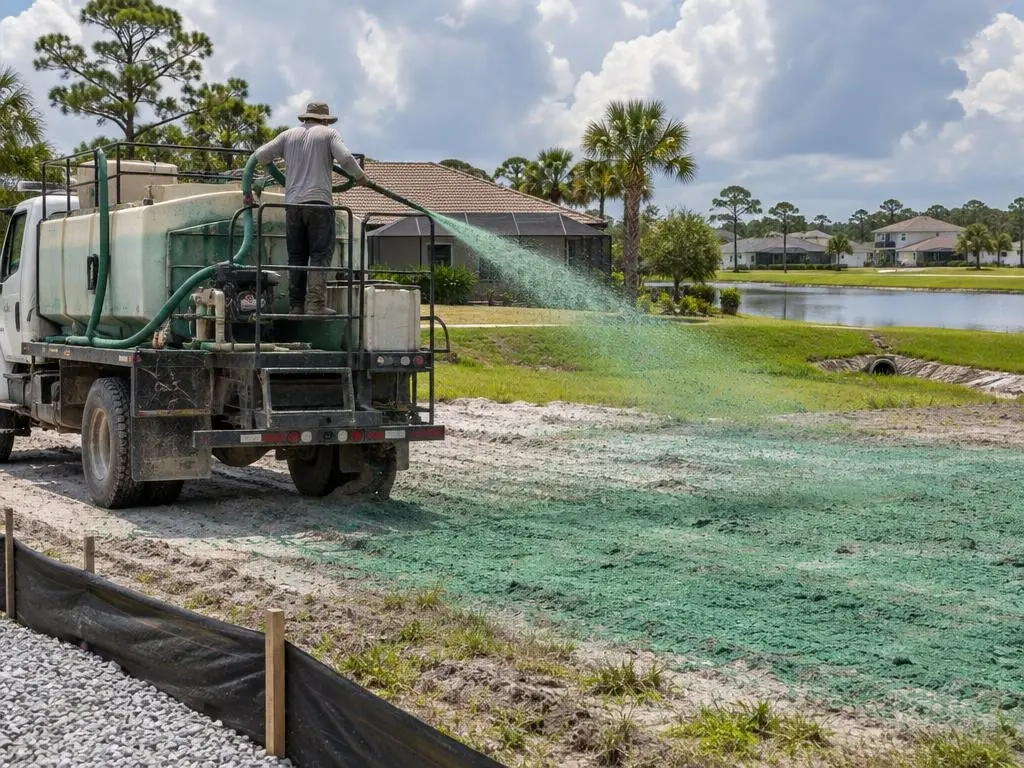
Why Homeowners Call Tampa Hydroseeding
We say when seed is wrong
St. Augustine lawns and steep mounds need sod. We tell you before you spend money on seed.
Planned for summer storms
Slurry rates, tackifier and blankets are chosen so seed stays put through afternoon downpours.
Soil prep on the estimate
Compacted construction sand gets tilled and amended, and it is priced as its own line.
Erosion controls first
On building sites, the City of Tampa expects sediment barriers and storm drain filters in the ground before the dozer starts, and that is how we sequence it.
Common Questions
What is hydroseeding?
Hydroseeding is a way of planting grass by spraying a mix of seed, mulch, fertilizer, a tackifier that helps it stick, and water onto prepared soil. The mulch holds moisture around the seed and keeps it from washing or blowing away. It is used for new lawns, construction sites, slopes and ditch banks.
What type of grass is best for Tampa?
It depends on how the lawn will be watered and whether you want to seed or sod. St. Augustinegrass is common here but only comes as sod, plugs or sprigs. For seeded lawns, bahiagrass handles sandy, infertile soil and dry spells well and is a good fit for large or unirrigated areas, while centipedegrass is a lower-input option for central Florida. We recommend a grass after seeing the sun, soil and irrigation.
Is October too late to hydroseed in Tampa?
Not for every grass. UF/IFAS says bahiagrass can be established any time of year in much of Florida, though growth slows as it cools. Centipedegrass is different: UF calls fall seeding undesirable and puts its window at April through July. October also starts the dry season, so plan on irrigation.
How much does hydroseeding cost?
National guides put it at roughly $0.07 to $0.26 per square foot (Angi) or $0.12 to $0.35 (HomeGuide). HomeGuide also says most outfits won't mobilize for less than $300 to $500 or more. Grading, topsoil, slopes and blankets add to that. After we measure your ground, you get a written price, and the bill does not move from it.
When can I mow new hydroseed in Tampa?
Under good conditions seed starts sprouting within about a week, and HomeGuide puts the first cut at 4 to 6 weeks out. Slow-germinating grasses like bahia can take longer. Mow high the first few times and keep heavy traffic off it.
Do I have to water a hydroseeded lawn during the rainy season?
Usually less, but not never. Even in summer there are dry days, and the top half inch of sand dries fast. Keep the surface damp until the grass is up and established, and skip watering after a real soaking storm.
Can you hydroseed over an existing lawn?
Over a thin bahia or centipede lawn, yes, after mowing low and loosening the soil so seed reaches it. Over St. Augustine, seed will not blend in because that grass is not grown from seed; patching it with sod or plugs works better. See our lawn patching page for details.
Neighborhoods and Towns We Cover
We work across Tampa and Hillsborough County and into Pasco and Pinellas. East of the city, Brandon, Valrico, Seffner, Plant City and Thonotosassa sit on inland flatwoods and old farm and grove land, and Plant City sees colder winter nights than the coast. To the south, Riverview, FishHawk, Lithia, Apollo Beach, Ruskin and Sun City Center range from master-planned communities to rural acreage along the Alafia and Little Manatee rivers, with canal-front lots near the bay. Temple Terrace has real slopes down to the Hillsborough River. North of the city, Wesley Chapel, Land O' Lakes and Zephyrhills have new subdivisions, preserves and rolling ground, and New Port Richey sits on the Pithlachascotee River. Across the bay we serve St. Petersburg, Clearwater, Largo, Oldsmar, Safety Harbor and Tarpon Springs, where Pinellas County sets its own stabilization rules. Open any town below for its soil, water and local rules.
- Hydroseeding in Tampa, FL
- Hydroseeding in Brandon, FL
- Hydroseeding in Riverview, FL
- Hydroseeding in Valrico, FL
- Hydroseeding in FishHawk, FL
- Hydroseeding in Lithia, FL
- Hydroseeding in Plant City, FL
- Hydroseeding in Temple Terrace, FL
- Hydroseeding in Thonotosassa, FL
- Hydroseeding in Seffner, FL
- Hydroseeding in Apollo Beach, FL
- Hydroseeding in Ruskin, FL
- Hydroseeding in Sun City Center, FL
- Hydroseeding in Wesley Chapel, FL
- Hydroseeding in Land O' Lakes, FL
- Hydroseeding in Zephyrhills, FL
- Hydroseeding in New Port Richey, FL
- Hydroseeding in St. Petersburg, FL
- Hydroseeding in Clearwater, FL
- Hydroseeding in Largo, FL
- Hydroseeding in Oldsmar, FL
- Hydroseeding in Safety Harbor, FL
- Hydroseeding in Tarpon Springs, FL
Plan Your New Lawn or Seeded Site
We will walk your Tampa or Bay-area property and hand you a written quote, free of charge.